

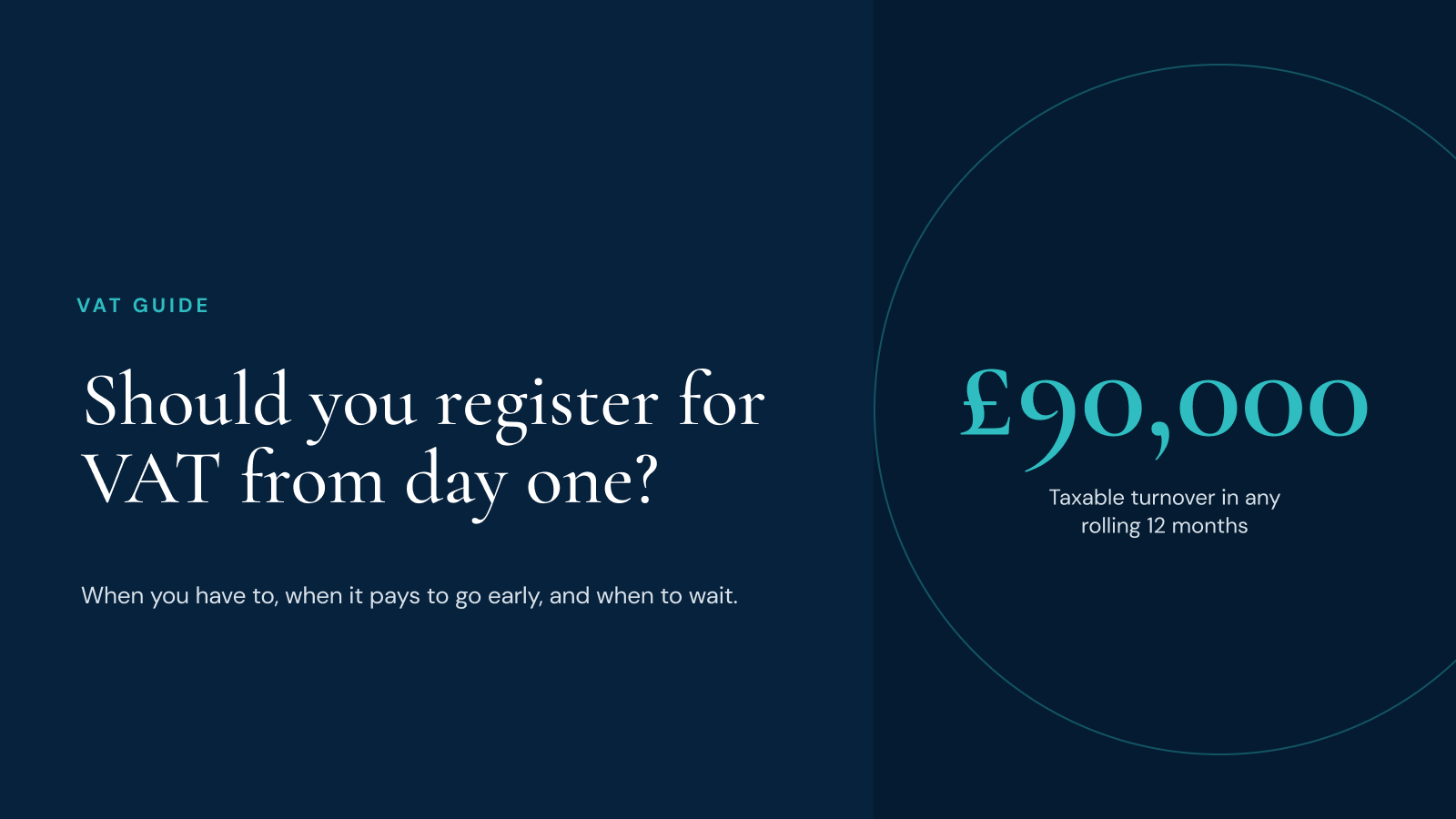
Should You Register for VAT From Day One?
Starting a business comes with plenty of decisions, and VAT registration is one that can cause confusion early on.
You don’t necessarily need to register for VAT as soon as you start trading. For some businesses, registering early can be useful. For others, waiting until registration becomes necessary may make more sense.
The right approach can depend on who your customers are, the costs your business has and the type of income you receive.
When do you need to register for VAT?
VAT registration is generally required when your taxable turnover goes over £90,000 in any rolling 12-month period.
The important part is “rolling 12 months”. It isn’t based on the tax year or your company’s accounting year. Instead, you need to keep an eye on your taxable turnover across any consecutive 12-month period as your business grows.
Once registration is required, you will usually have a 30-day period to notify HMRC.
However, businesses can also choose to register before reaching the threshold. This is known as voluntary VAT registration.
When could registering early make sense?
There are a few reasons a business may decide to register voluntarily.
You have eligible business costs
Once registered, you may be able to recover VAT on qualifying business expenses, such as eligible equipment, stock, software and other costs.
For businesses with significant VAT-bearing expenditure, this can make voluntary registration worth considering.
Your customers are VAT-registered businesses
If your customers are themselves VAT registered and can recover the VAT you charge, VAT registration may have less of an impact on the overall cost to them.
This is one reason early registration can sometimes suit businesses that mainly work with other businesses rather than members of the public.
Some clients may expect it
Larger businesses may prefer to work with VAT-registered suppliers, so there can also be commercial reasons for registering.
You have already spent money setting the business up
Subject to the usual conditions, you may be able to recover VAT on some costs incurred before registration.
This can include VAT on certain goods bought within the previous four years that you still have, and services purchased within the previous six months.
When might it be better to wait?
Registering voluntarily isn’t automatically beneficial.
There is more administration
VAT registration means keeping digital records and submitting VAT returns, usually quarterly, under Making Tax Digital.
That means additional administration and potentially more bookkeeping work.
It can affect prices for the public
For businesses selling mainly to members of the public, VAT can have a bigger impact.
For example, a £100 service charged at the standard VAT rate would become £120 if the VAT is added to the existing price. Alternatively, the business may choose to absorb some or all of the VAT, reducing its margin.
Your bookkeeping may become more complicated
Businesses dealing with different VAT rates, exempt income or overseas sales can face a more complicated VAT position.
There may be higher accountancy costs
Additional VAT records and returns can mean more work each year, which may also increase accountancy costs.
A useful rule of thumb
Early registration tends to be more suitable for businesses that:
● mainly sell to other VAT-registered businesses
● have significant VAT-bearing costs
Waiting may make more sense for businesses that:
● mainly sell to the public
● have relatively few VAT costs to recover
It isn’t a rule that applies to every business, but it can be a useful starting point.
Work in financial services? There is another consideration
VAT can work differently in financial services.
Most insurance and many financial services, including activities such as arranging mortgages, protection or investments, are exempt from VAT.
Exempt income does not count towards the VAT registration threshold.
If your business makes only exempt supplies, you generally cannot register for VAT on that activity or recover the related VAT on your costs.
Many advisers, however, receive a mixture of taxable and exempt income. If that applies to you, it is worth getting advice before deciding whether VAT registration is appropriate.
Should you register early?
There is no single answer that suits every business.
Who you sell to, what you spend and the type of income you receive can all affect whether voluntary VAT registration makes sense.
We’ve put the key considerations into our VAT factsheet, available to download below, so you can see the main points at a glance.
If you’re unsure where your business stands, you can also book a free discovery call with the Insight Tax & Accountancy team.
This article provides general guidance based on the rules in force in September 2026. It is not advice for your individual circumstances.


