

Can Your Company Pay for Your Training?
If you run your business through a limited company, the company can usually pay for your training and, in many cases, claim Corporation Tax relief on the cost.
Training is often one of the best investments a business can make. But there are conditions, and the rules for companies are not the same as the rules for sole traders.
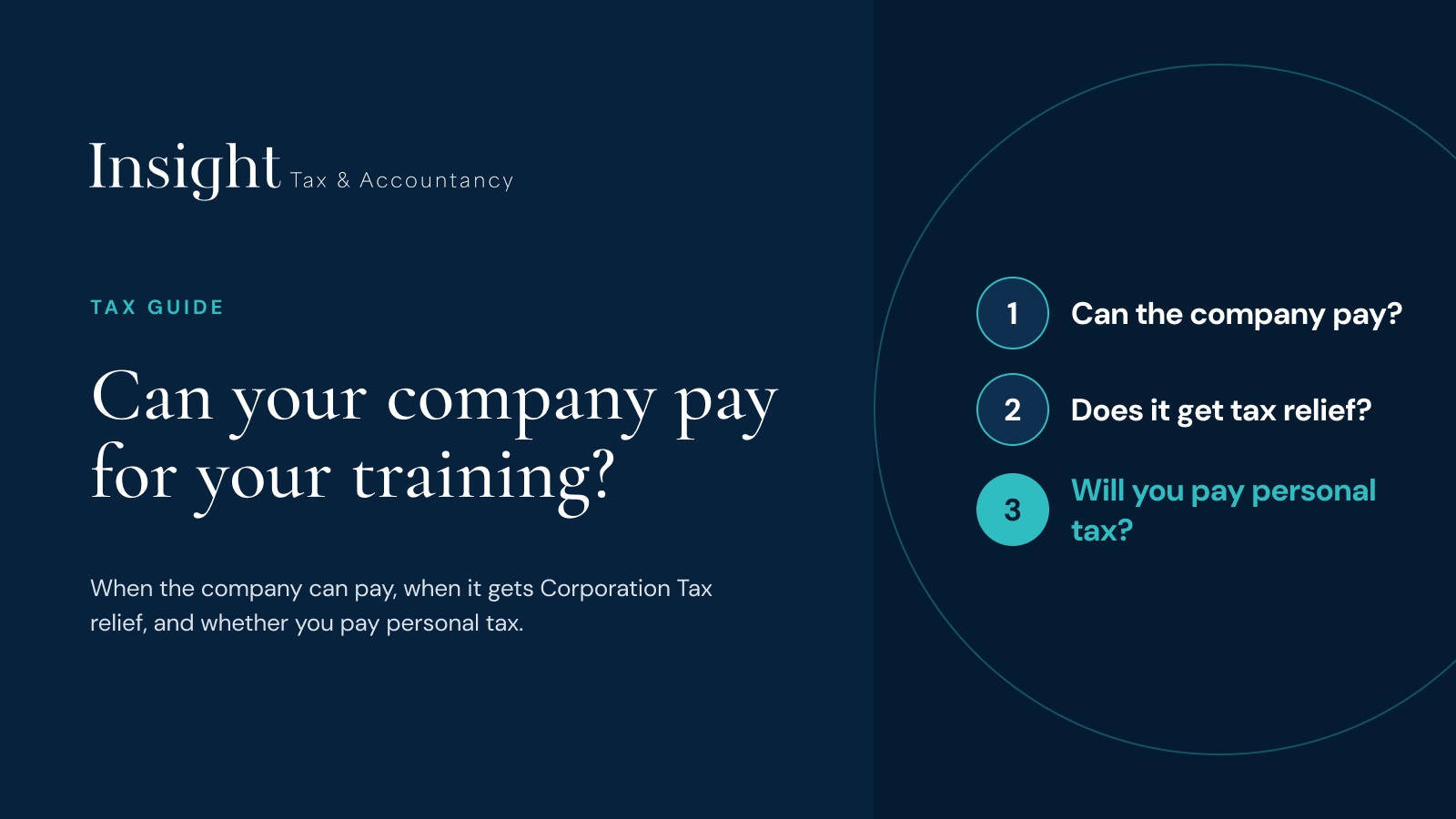
There are three questions to consider:
- Can the company legitimately pay for the training?
- Will the company get Corporation Tax relief on the cost?
- Will you pay personal tax on it?
Limited companies and sole traders are treated differently
The rules depend on how your business is set up.
Sole traders. Training that keeps your skills up to date, or develops new skills for your existing business, is generally allowable. Training to move into a completely new or unrelated trade or profession generally is not.
Limited companies. A company is a separate legal entity. Training it provides for its directors and employees can qualify for tax relief even where it involves learning entirely new skills, as long as it is for the purposes of the company's business.
The rest of this article focuses on limited companies.
Can the company pay for the training?
Yes, where there is a genuine business reason for it.
The training should benefit the company. For example, it might help you do your current role better, prepare you to take on new responsibilities, or support an area the business is moving into.
The simplest approach is for the company to book and pay for the training directly, with the invoice in the company's name. That makes it clear from the start that the cost belongs to the company.
Will the company get Corporation Tax relief?
Often, yes. To be deductible, a cost must be incurred wholly and exclusively for the purposes of the company's trade.
Training for directors and employees is generally treated as a staff cost, and it can qualify even where the skills are new to the person being trained.
Take extra care if you own the business
Where the director is also the owner, it can be harder to show that training was for the company rather than for you personally. Training that is mainly for personal interest, or for a career outside the business, is unlikely to qualify.
It helps to keep a short note of why the company is funding the training and how it relates to the business.
Will you pay personal tax on it?
Usually not, if the training is work-related.
When a company pays for something on a director's behalf, it can normally be treated as a taxable benefit. Training has its own exemption under Section 250 of the Income Tax (Earnings and Pensions) Act 2003.
Under this exemption, there is generally no income tax or National Insurance on training your company funds or reimburses, where the training is likely to be useful in your work for the company or helps you qualify for that work. It can also cover related costs such as course materials and exam fees.
Training that is not work-related may still be taxable on you, even if the company pays for it.
What if you have already paid personally?
Paying for training yourself does not automatically make it a company cost. There must be a genuine company liability. That means the training must be for the company's business, and the company must have agreed to bear the cost.
Where that is the case, the amount the company owes you can be recorded through your director's loan account and repaid once the company has the funds.
The director's loan account is only the record of what is owed. It does not make the training tax-deductible, and it does not change how the cost is taxed.
Training paid for before the company existed
This needs separate consideration. A company cannot simply take on a cost that was incurred before it was formed, so training you paid for before incorporation does not automatically become a company expense.
If you paid for training before setting up your company, speak to your accountant before putting it through the company's books.
Keep your paperwork
Whether the company pays directly or reimburses you, keep:
- invoices, ideally in the company's name
- receipts and proof of payment
- details of the course and what it covers
- a short note of the business reason for the training
These records support the company's tax treatment and show what, if anything, the company owes you.
So, can your company pay for your training?
In many cases, yes. Where there is a genuine business purpose, a limited company can usually fund training for its directors and employees, claim Corporation Tax relief, and do so usually without a personal tax charge for the person trained.
The details matter, particularly if you own the business, paid for the training yourself, or paid before the company was formed.
We've summarised the key points in our Training Costs factsheet.
[Link to download the Training Costs factsheet]
If you're unsure how a particular training cost should be treated, you can also book a free discovery call with the Insight Tax & Accountancy team.
This article provides general guidance based on the rules in force in October 2026. It is not advice for your individual circumstances.


